
Trust is a design decision
What your customers are worried about when AI is involved, and why it's a design decision, not a tech problem

Trust is a design decision
“It takes 20 years to build a reputation and five minutes to ruin it. If you think about that, you’ll do things differently.” Warren Buffett said that before AI existed. I’ve been thinking about what it means now that we’re in the AI era — specifically, what would change, if anything, about how we earn and maintain customer trust.
The obvious first question is whether AI makes that easier or harder. The more I pull on it, the less obvious the answer gets.
Because it’s both. A well-designed AI system can be more consistent than any human team — no bad days, no variance between customers, no forgetting what someone shared last month. In that sense, AI can actually strengthen some of the things that build trust. But it also introduces failure modes that didn’t exist before at this scale. Confident wrong answers. Decisions nobody can explain. Accountability that dissolves the moment something goes wrong. Data flowing through systems nobody fully mapped.
The “easier or harder” question only gets you so far. That question kept bumping into a prior one: what do we even mean by trust?
Merriam-Webster defines trust as “assured reliance on the character, ability, strength, or truth of someone or something” — in other words, the belief that something (or someone) will behave as expected. In business, that belief has always rested on a few specific pillars. AI doesn’t change the pillars. It changes who (or what) is responsible for holding them up. And that changes everything about what you have to do to earn it.
The 6 dimensions of customer trust
Customer trust in the AI era breaks into 6 dimensions. Each is affected by AI differently — and the “easier or harder” answer is different for each. Not quite MECE (the edges overlap in places), but the taxonomy holds, and it’s the right place to start.
1. Output trust: can the output be trusted?
Output trust covers any AI-generated result your customers receive, act on, or are evaluated by — a recommendation, a report, a decision. The failure mode is hallucination: confident, coherent, wrong. The question is what your system does about it before it reaches the customer.
2. Process trust: can customers understand how?
Even when the output is correct, the inability to explain how AI reached its conclusion creates its own problem. Customers receiving an AI-assisted decision — on a loan, a service tier, a maintenance priority — increasingly expect to understand the reasoning. The right to understand and challenge that reasoning is becoming a baseline expectation.
3. Accountability trust: who owns it when something goes wrong?
When AI makes a mistake and accountability is unclear, customers experience the worst of both: the speed and efficiency of automation, combined with the helplessness of having no human to reach when it fails. Companies that handle this well design clear governance and accountability before any incident. I wrote more on accountability in the Who Owns This? piece.
4. Data trust: what happens to my data?
Customers increasingly assume their data is being used in ways they haven’t consented to — and that assumption is affecting whether they stay, switch, or trust at all. Data trust has moved out of IT and legal, and squarely into retention, pricing, and brand.
5. Fairness trust: am I being treated equitably?
In any context where AI makes decisions that affect customers differently based on who they are — eligibility, pricing, service access — fairness trust is at stake. The failure mode is quiet. A model that performs well on average while systematically disadvantaging specific groups rarely surfaces until it becomes a headline.
6. Environmental safety trust: is the environment safe?
This dimension applies mainly to platforms and intermediaries — where third parties produce content, sell products, or transact within an ecosystem you host. Dating apps, marketplaces, news aggregators, ad networks, supply chain platforms. Your customers rely on you to have screened what flows through you. AI is now the primary tool for safety enforcement and the primary tool bad actors use to evade it.
Across all 6, the research tells a consistent story: awareness of these risks is high; action on them is not. Most organizations can name the problem. Far fewer have designed their way out of it. The supporting data, by dimension, is in the sources section at the end.
Easier or harder? The full answer.
Go back through those 6 dimensions and the answer looks different depending on how you design for the role of AI. AI can strengthen output consistency if you build verification in. It makes process trust harder, almost by definition: the more powerful the model, the harder it is to explain. It can sharpen data governance or erode it entirely, depending on how you’ve set things up.
Not a technology problem, a design problem.
One thing holds across all 6: trust has to be built in from the start. Not patched in later with a privacy notice, a disclaimer buried in the footer, or a carefully worded apology after something goes wrong. Designed in, as a product decision, made before deployment.
What this series covers
It’s a large topic. I’m covering it in 2 pieces.
This one focuses on the customer: what your customers are actually worried about across these 6 dimensions, and what it looks like to design for each of them. Part 2 covers the internal side — the trust relationship between employers and employees in the AI era, and operational trust in your own AI systems. Both pieces share one underlying principle.
The disclosure principle
When AI is consequentially involved in something that affects your customers, they’re entitled to know. At the point where it matters, in language a reasonable person understands, not buried in a terms of service document they’ll never read.
It matters for several reasons. Some interactions people simply expect to involve another human, and that expectation deserves more than a workaround. It’s the right thing to do, independent of what the law requires. Regulators are catching up fast. And customers who don’t know they’re dealing with AI can’t calibrate their own judgment or push back when something feels wrong.
The disclosure principle runs through every dimension above.
Trust by design: the how
Understanding which dimensions matter most for your customers is the diagnostic. The design work is what comes next.
Trust has to be built across 4 levers that every business controls: the product itself, customer communications, formal disclosures, and internal policies and governance. The matrix below maps specific design decisions across all 6 dimensions and all 4 levers.
Use it as a design brief: the decisions that need to be made before AI touches any customer-facing context.
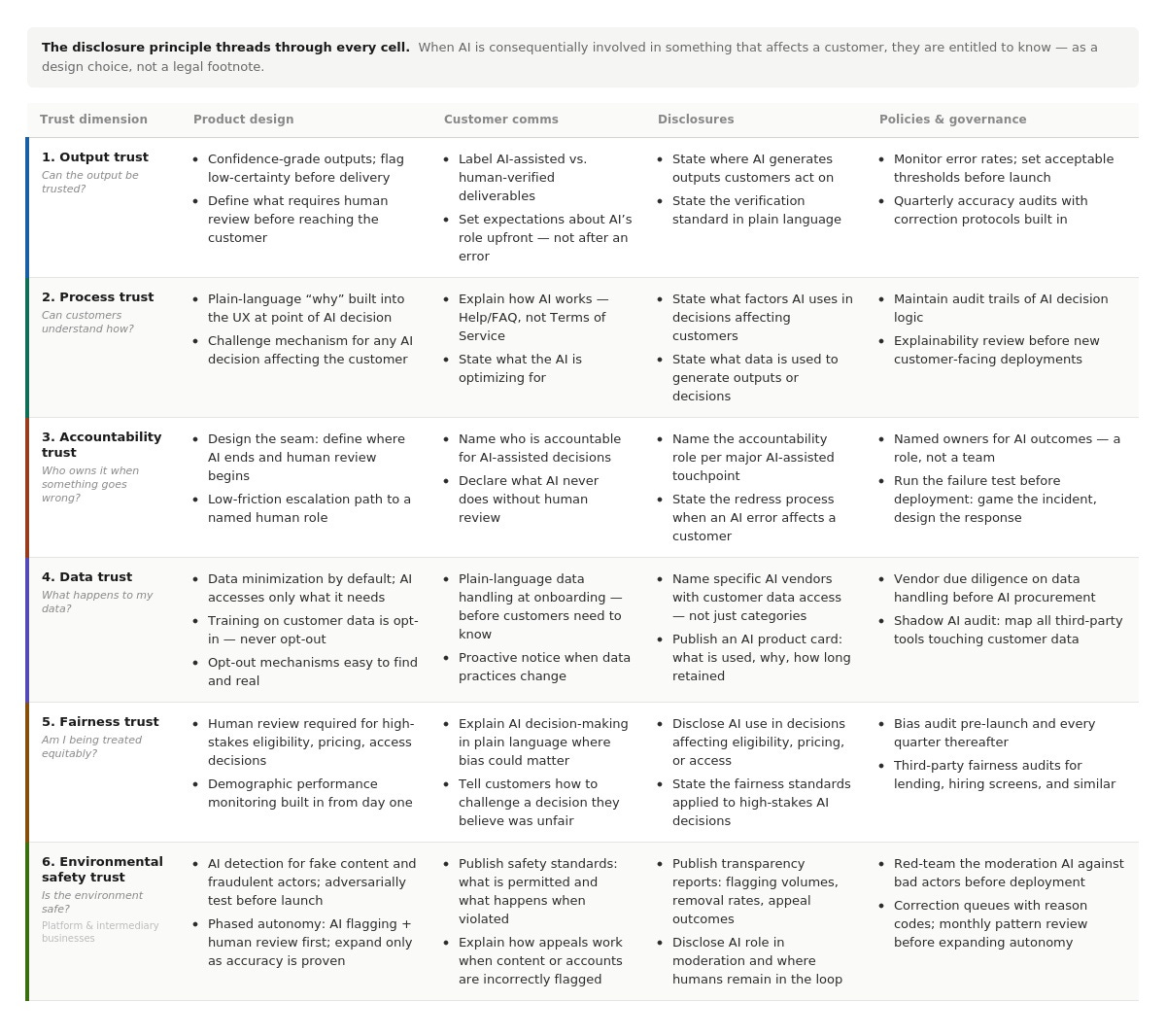
A few things this framework makes clear. Most trust decisions are product decisions, not communications decisions. Governance matters more than policy documents: named owners, failure testing, audit cadences, and correction loops are what actually work. And the disclosure principle runs through every cell, as a design choice made at the start, not a disclaimer added at the end.
The competitive case
The companies building trust into their AI deployments right now aren’t moving slower. They’re building something that compounds. Trust built in from the start holds. And customers who’ve been failed by AI remember the companies that designed for them differently.
Part 2 covers the other side: how AI is reshaping the trust relationship with your employees and your own systems, and what designing for that looks like.
Build it in.
Which of these 6 dimensions is your company most exposed on right now? I’d start there.
— Kalina
Written in partnership with Claude Sonnet 4.6
Data & sources
Output trust 74% of enterprise respondents identify inaccuracy as their most cited AI risk. McKinsey AI Trust Maturity Survey, March 2026.
Process trust 44% of respondents identified “Autonomous or unintended system actions” as a key AI risk; only 29% were actively working on it. Active mitigation continues to lag behind risk awareness across nearly every risk category — documented in 2024 and confirmed again in 2026. McKinsey State of AI, Early 2024; McKinsey AI Trust Maturity Survey, March 2026.
Accountability trust By 2027, 74% of respondents expect their companies to be using AI agents at least “moderately.” … Yet approximately 80% of the organizations surveyed currently lack mature governance capabilities for agentic AI, such as clear boundaries for agents that define which decisions they can make independently versus which require human approval, real-time monitoring systems that track agent behavior and flag anomalies, and audit trails that capture the full chain of agent actions to help ensure accountability and enable continuous improvement. Deloitte’s 2026 State of AI in the Enterprise
Data trust: Eighty-two percent of surveyed gen AI users and experimenters now say the technology could be misused (up from 74% last year). One-third of surveyed users say they’ve encountered incorrect or misleading information when using gen AI, and 24% report they’ve had data privacy issues. Deloitte’s 2025 Connected Consumer Survey
Environmental safety trust Over 3,000 AI-generated content farm websites identified across 16 languages as of March 2026. NewsGuard AI Tracking Center.
Definition Trust: “assured reliance on the character, ability, strength, or truth of someone or something.” Merriam-Webster.